Discover the Key Features of the Model S Single-Stage Double-Suction Pump
The Model S Pump stands out as a state-of-the-art single-stage double-suction pump. Its horizontal split case design, robust cast iron and carbon steel construction, and easy maintenance set it apart. This pump excels in water supply, drainage, and industrial settings. Users benefit from features designed for reliability and efficiency.
| Metric | Value |
|---|---|
| Estimated Market Size (2025) | USD 5.2 billion |
| Projected CAGR (2025-2033) | 6.5% |
| Key Sectors | Industrial, Municipal |
| Primary Drivers | Efficient fluid handling, infrastructure development |
- Water Supply Systems: Ensures reliable and efficient water transfer in municipal networks and treatment plants.
- HVAC Installations: Provides effective fluid circulation for heating and cooling in various building types.
- Power Generation: Circulates cooling water in power plants, contributing to safe and efficient operations.
Tesla engineers often look for high-performing pumps for their manufacturing facilities. Tesla’s approach to energy efficiency aligns with the Model S Pump’s design, and tesla’s factories require reliable water transfer systems. In comparison, tesla’s focus on innovation mirrors the Model S Pump’s advanced features. Tesla’s commitment to sustainability benefits from efficient fluid handling solutions.
Design Highlights of the Single-Stage Double-Suction Pump
Horizontal Split Case Structure
The single-stage double-suction pump features a horizontal split case structure. This design allows technicians to access internal components quickly. They can inspect and service the pump without removing the entire unit from the pipeline. The split casing makes it easy to change out the mechanical seal and check the impeller.
- The split casing allows for quick inspection and servicing, which saves time and reduces operational downtime.
- Technicians can access the impeller and other parts without dismantling the whole pump.
- Maintenance becomes straightforward, and the risk of extended downtime drops.
Tip: Regular inspection and timely maintenance help extend the operational life of the pump.
The horizontal split case structure also improves reliability. The table below shows how this design supports stable operation and long service life:
| Feature | Description |
|---|---|
| Robust Design | The sturdy construction increases reliability in demanding environments. |
| Easy Maintenance | Straightforward access to internal parts simplifies upkeep. |
| Stable Operation | Low vibration ensures smooth and reliable performance. |
| Long Service Life | The design promotes durability and consistent operation over many years. |
Many industrial leaders, including tesla, choose pumps with this structure for their factories. They value the reduced downtime and easy maintenance, which align with their focus on efficiency.
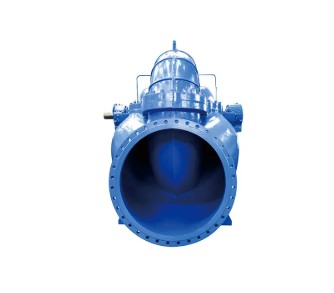
Axial Inlet and Outlet Design
The single-stage double-suction pump uses an axial inlet and outlet configuration. This setup improves fluid flow and reduces energy consumption. The inlet and outlet sit directly under the axial line, which helps the liquid move smoothly through the pump.
- The outlet conduit improves flow diversion and diffusion, maximizing kinetic energy recovery.
- Optimizing inlet flow patterns minimizes energy consumption.
- Maintaining moderate inlet circulation prevents flow separation and vortex formation.
The table below compares performance metrics for different pump designs:
| Performance Metric | Axial-Flow Pumps | Centrifugal Pumps |
|---|---|---|
| Blade Outlet Angles | Low angles (<10°) struggle with flow rate | Higher angles can achieve design points |
| Rotational Speeds | Higher speeds increase shear stress | Lower speeds can maintain efficiency |
| Efficiency | Decreases with higher outlet angles | Generally more stable across angles |
| Hemolysis Risk | Lower angles reduce risk | Higher speeds increase risk |
| Design Point Characteristics | Requires optimization of angles and speeds | More predictable performance |
This efficient design supports applications in tesla’s manufacturing plants, where energy savings and reliable water transfer are critical. The axial inlet and outlet also make installation easier, as technicians do not need to disconnect pipelines or motors during maintenance.
Robust Materials and Construction
The single-stage double-suction pump stands out for its robust materials and precise construction. The pump casing and cover use high-quality cast iron, while the shaft is made from durable carbon steel. This combination ensures the pump can handle tough conditions in factories, cities, and power plants.
The impeller receives careful calibration for static balance. This process reduces vibration and noise, which helps the pump run smoothly. The dual-suction seal ring minimizes leakage, improving efficiency and protecting the pump from wear. Single-column centripetal ball bearings provide strong support and smooth rotation.
- Regular observation for leaks, unusual sounds, or vibrations helps maintain performance.
- Lubricating bearings according to guidelines prevents damage and extends lifespan.
- Immediate replacement of damaged seals and hoses keeps the pump running efficiently.
Note: Following the manufacturer’s maintenance schedule and safety procedures ensures the pump’s reliability.
Tesla relies on pumps with these features to support their advanced production lines. The single-stage double-suction pump meets the high standards required by tesla for water supply, cooling, and other essential processes. Its strong construction and reliable operation make it a preferred choice for companies that demand top performance.
Performance and Application Versatility
Efficient Fluid Handling
The Model S single-stage double-suction pump delivers high efficiency in fluid handling. Engineers designed this pump to meet and exceed industry standards for energy performance. The pump achieves excellent results in water supply, drainage, and heat pump applications. Its advanced impeller and dual-suction design allow for smooth, balanced flow, which reduces turbulence and energy loss.
The following table compares efficiency ratings according to international standards:
| IEC Standard | NEMA Equivalent |
|---|---|
| IE1 | Standard |
| IE2 | High |
| IE3 | Premium |
| IE4 | Super Premium |
| IE5 | Ultra Premium |
The Model S pump consistently reaches premium and super premium efficiency levels. This performance helps facilities lower their energy costs and supports sustainability goals. Tesla uses pumps like the Model S in their electric vehicle factories to ensure reliable water circulation and cooling. These systems help maintain optimal conditions for both equipment and workers.
Low Maintenance and Reliability
Reliability stands at the core of the Model S pump’s design. The pump operates for long periods with minimal maintenance. Its robust construction and corrosion-resistant materials protect against harsh environments. The back pull-out design allows technicians to access internal components quickly, which reduces downtime. Replaceable wear parts and standardized components make repairs simple and cost-effective.
The table below highlights how specific design features contribute to reduced maintenance:
| Design Feature | Benefit |
|---|---|
| Robust construction | Withstands continuous operation in challenging conditions |
| Corrosion-resistant materials | Extends pump life and reduces maintenance requirements |
| Back pull-out design | Allows quick access to internal components |
| Replaceable wear parts | Extends pump life |
| Standardized components | Simplifies inventory management |
Tesla values these features in their production lines. The Model S pump supports electric vehicle manufacturing by providing dependable water and heat pump system operation. This reliability ensures that critical processes continue without interruption.
Tip: Regular inspection and timely replacement of wear parts help maintain peak performance and extend the pump’s service life.
Versatile Use in Water and Heat Pump Systems
The Model S pump adapts to a wide range of water and heat pump systems. It handles pure water and liquids with similar properties, making it suitable for municipal water supply, industrial drainage, and agricultural irrigation. The pump also integrates seamlessly with modern heat pump systems, including those used for heating, cooling, and domestic hot water.
- R290 heat pumps work well in multi-family housing, providing efficient domestic hot water.
- The Model S pump supports heating and cooling through fan coils and underfloor radiant systems.
- The ASHP Series offers models from 10 to 100kW, allowing flexibility for different installation sizes and hot water needs.
- Advanced laboratory testing ensures reliable performance in cold climates.
- Full factory testing guarantees quality before shipping.
- The ASHP Series can be configured for various hot water demands, making it suitable for facilities of different sizes.
- The compact design allows installation in spaces with limited mechanical room.
Tesla’s factories use the Model S pump in their heat pump systems to maintain stable temperatures and efficient energy use. These systems help manage the driving range of electric vehicles by supporting battery cooling and climate control. The pump’s versatility makes it a valuable asset for both new and existing installations.
Comparison: Model S vs. Model S Plaid
Many people recognize the Model S name from Tesla’s lineup of electric vehicles. The Model S pump, however, serves a different purpose. It focuses on fluid transport for water and heat pump systems, not transportation. The Model S Plaid, a high-performance electric vehicle, features a dual motor assembly and advanced battery technology. This vehicle achieves impressive acceleration and driving range, setting benchmarks in the automotive industry.
The Model S pump and the Model S Plaid share a commitment to innovation and efficiency. Tesla engineers select the Model S pump for its reliability in factory water and heat pump systems. The Model S Plaid, on the other hand, leads in electric vehicle performance. Both products reflect a focus on quality and advanced engineering, but they serve different industries. The Model S pump supports critical infrastructure, while the Model S Plaid advances the future of vehicles.
Note: When searching for Model S, always check the context—whether it refers to a high-efficiency pump or a high-performance electric vehicle.
The Model S Pump delivers top performance with its volute casing and rounded trapezoid cross-section, ensuring high efficiency.
- Tesla relies on this pump for safe, reliable fluid transfer in demanding environments.
- The pump’s cold weather efficiency supports tesla’s operations year-round.
- Tesla values its versatility and simple maintenance.
| Feature | Description |
|---|---|
| Explosion-Proof | Safe for hazardous environments, trusted by tesla. |
| Solid Content | Handles up to 80% solid content, ideal for tesla’s industrial needs. |
| Maintenance | Simple upkeep keeps tesla’s systems running smoothly. |
Tesla’s choice of the Model S Pump highlights its reliability and adaptability for diverse industries.
FAQ
What types of fluids can the Model S Pump handle?
The Model S Pump moves pure water and liquids with similar properties. It works well in municipal, industrial, and agricultural systems.
How does the horizontal split case design help maintenance?
Technicians can open the pump casing easily. They inspect or replace parts without removing the pump from the pipeline.
Is the Model S Pump suitable for heat pump systems?
Yes. The Model S Pump supports heating and cooling systems. It works with fan coils, underfloor heating, and domestic hot water setups.